There’s a reason certain phrases—“I feel sick,” “My body is falling apart,” “I’m old,” “I always get headaches”—can seem to pull symptoms closer. It’s not magic. It’s a well-studied mind–body phenomenon: expectation can shape biology.
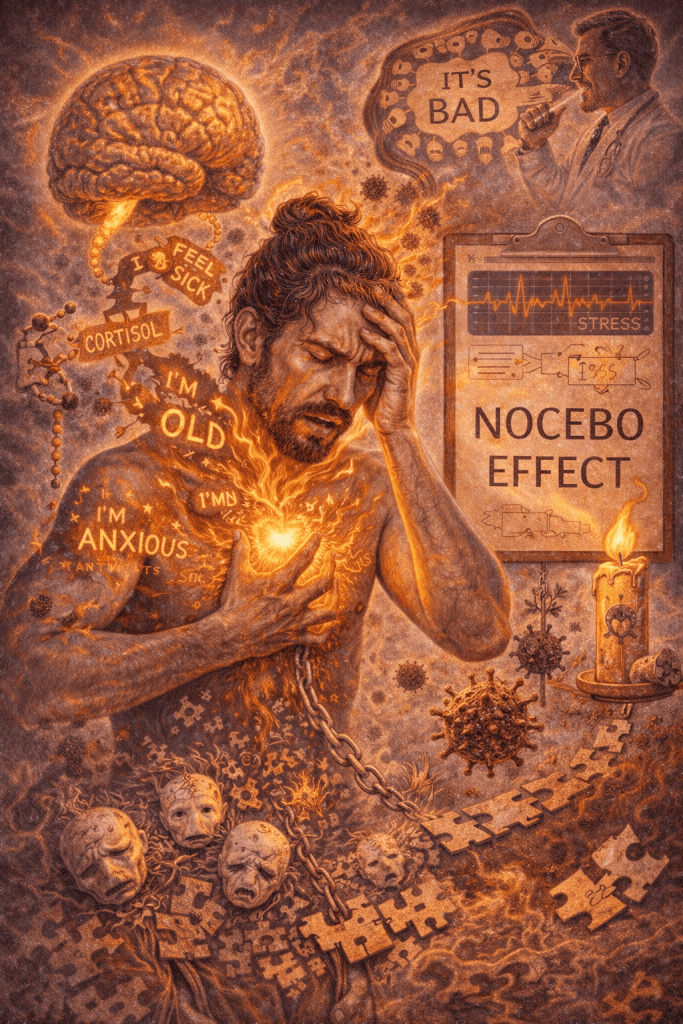
That phenomenon has a name: the nocebo effect—the “negative placebo.” It describes real symptoms or worse outcomes that occur because someone expects harm, often triggered by fear, suggestion, or the way information is framed.
What the nocebo effect actually is
A nocebo response can show up as pain, nausea, dizziness, fatigue, itching, and other symptoms—even when a “treatment” is inert—because the brain predicts a negative outcome and the body responds accordingly. Researchers describe mechanisms like expectation, learning/conditioning, and negative suggestions (especially in medical contexts).
A simple example: two people get the same injection, but the person who’s warned “this will hurt” often reports more pain than someone given a calmer framing—same stimulus, different expectation.
“Your body obeys your voice” — what science supports (and what it doesn’t)
The strongest scientific version of this idea is:
- Words can change expectations.
- Expectations can change attention, interpretation of sensations, and stress physiology.
- Stress physiology can influence immune function and inflammation over time.
That’s psychoneuroimmunology: how mind, brain, hormones, and immune signaling interact.
Where people often overstate it is the timeline and certainty—e.g., “saying ‘I’m sick’ releases a cascade of cortisol that depresses your immune system in minutes.” Acute stress can raise cortisol (often peaking after a short delay), and chronic stress is more consistently linked with immune suppression, but the “minutes” claim is too absolute and doesn’t fit the broader evidence base.
How negative self-talk can become a stress amplifier
Your brain is a prediction engine. When you label yourself with threat language (“I’m breaking down,” “I’m always sick”), you can unintentionally:
- Prime threat detection (hypervigilance to bodily sensations)
- Increase symptom scanning (“Is my throat scratchy? Am I getting sick?”)
- Interpret normal sensations as danger
- Trigger stress arousal (fight/flight physiology)
- Reinforce the loop (“See? I knew it.”)
That loop is a common pathway by which nocebo effects become sticky—especially if you’ve had past experiences that trained your brain to expect problems.
The goal isn’t “positive vibes.” It’s accurate, regulated language.
You don’t need to deny reality. You just want language that reduces threat while staying honest.
Instead of:
- “I’m getting sick.”
Try: - “I’m noticing symptoms. I’m going to rest, hydrate, and monitor.”
Instead of:
- “I’m old—everything hurts.”
Try: - “My body needs more recovery and movement. I can support it.”
Instead of:
- “My anxiety is ruining me.”
Try: - “My nervous system is activated. I can help it settle.”
This kind of reframe doesn’t pretend symptoms aren’t real. It changes the meaning your brain assigns to them—often the difference between a calm response and a spiral. (This is also why clinician wording matters so much.)
A practical “anti-nocebo” script (30 seconds)
When you catch yourself using threat language, try this:
- Name: “I’m noticing a worry story.”
- Normalize: “My brain is trying to protect me.”
- Ground: “What’s true right now in my body?”
- Choose: “What’s one supportive action I can take?”
This shifts you from identity (“this is me”) to observation (“this is a moment”), which is where regulation lives.
Important reality check
- The nocebo effect is real, but it doesn’t mean illness is “all in your head.”
- If you have persistent or severe symptoms, get medical care.
- Think of language as a volume knob on stress and symptom experience—not an on/off switch.
 NO LABELS JUST HUMAN