I am learning how to live moment to moment.
Not as a destination to reach, but as an ongoing process of awareness, gratitude, and presence.
The human experience is vast and multidimensional. We don’t just live within our bodies we live within language, memory, culture, environment, and inherited patterns that shape how we feel and respond to life. Every experience leaves an imprint. Every interaction programs something within us, often without our conscious awareness.
I’m beginning to understand that the human vessel I operate is not separate from what I ingest emotionally, mentally, and energetically. The words I’ve absorbed, the stories passed down through my bloodline, the environments I’ve lived in, and the experiences along my timeline all contribute to how my nervous system reacts and how my mind interprets the world.
Language, in particular, is one of humanity’s most powerful tools. Words don’t merely describe reality they shape it internally. As a species with advanced intellect, we are highly susceptible to suggestion. The meanings we assign, the narratives we repeat, and the labels we accept become emotional instructions that guide our behavior and self-identity.
Other species live primarily through instinct fear, survival, pleasure, and response. Humans share the same biological foundations: organs that sustain life, lungs that receive oxygen, and nervous systems that react to threat. But what separates us is our capacity for abstraction. We think about thinking. We reflect. We imagine. We assign meaning.
This ability is both our greatest strength and our greatest challenge.
When awareness is absent, thought becomes overwhelming. Emotional consumption piles up. We absorb more than we process. Media, conversations, cultural pressure, and constant stimulation pull us away from the present moment, fragmenting our inner world. We live reactively instead of intentionally.
But awareness changes everything.
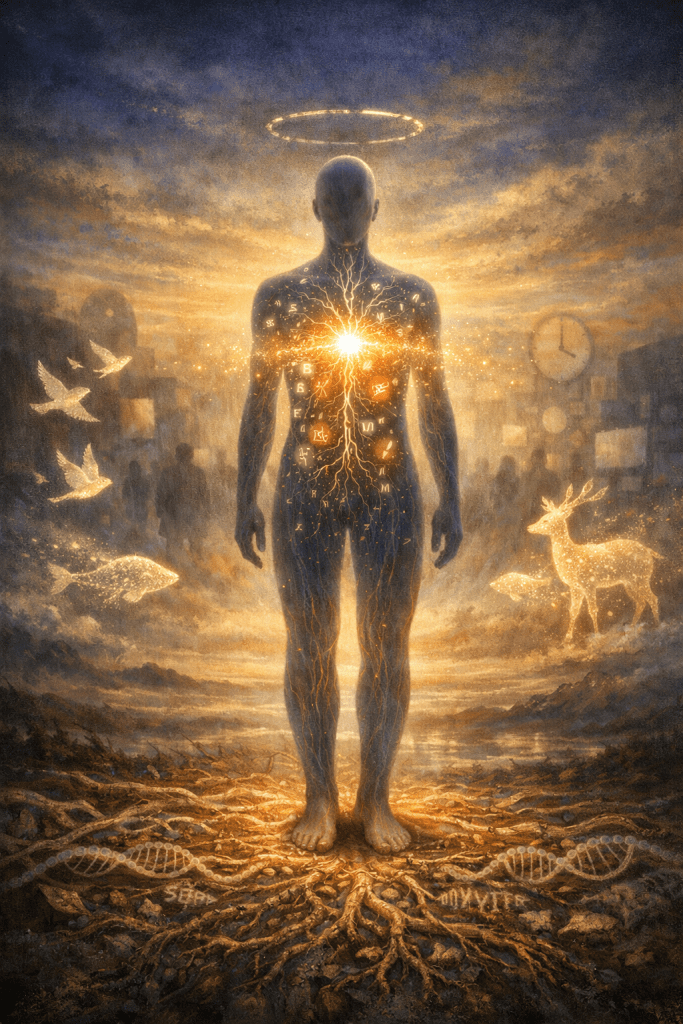
When we become conscious of what we consume emotionally, mentally, relationally we regain agency. We begin to notice how language shapes our inner experience, how environments influence our emotional state, and how unexamined patterns continue to repeat themselves. With awareness, we can choose differently.
Living in true existence, I’ve learned, doesn’t require escaping complexity. It requires understanding it. It asks us to meet life as it is without denial, without overwhelm, and without needing to control every outcome.
Gratitude becomes a grounding force. Presence becomes a stabilizer. Awareness becomes the bridge between experience and choice.
To be human is not to be flawless.
It is to be conscious.
To observe.
To learn.
To return again and again—to the moment where life is actually happening.
And in that return, we discover something essential:
we are not here to master life we are here to inhabit it.
 NO LABELS JUST HUMAN